

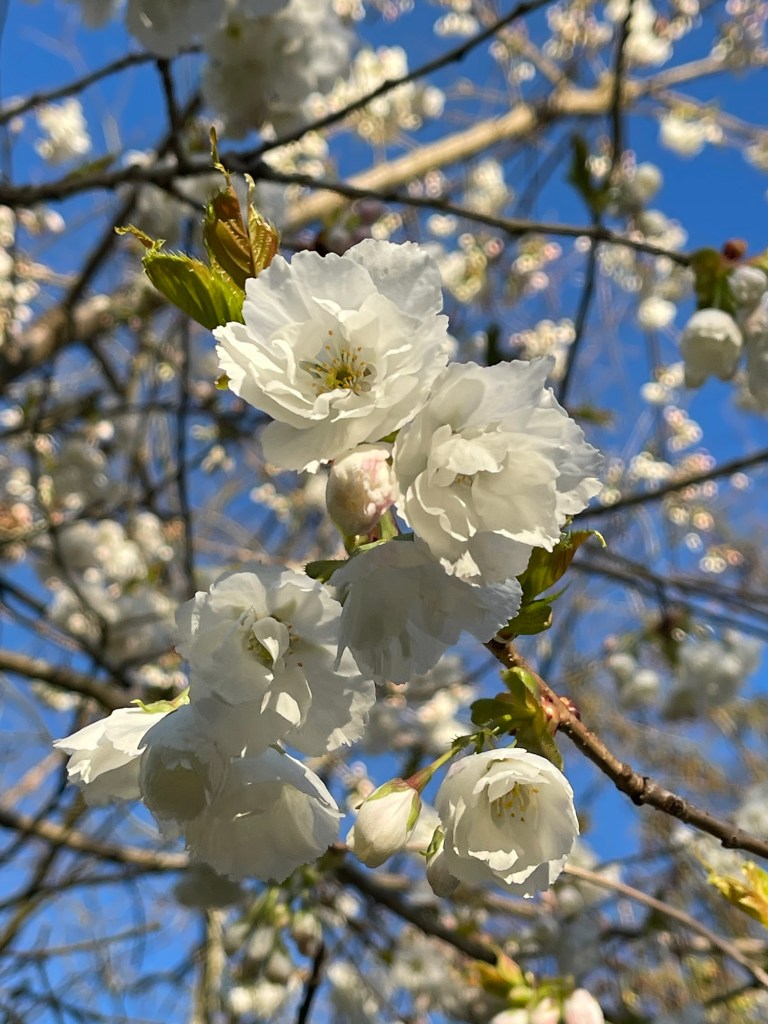
The cherry tree in our back garden is dying. I am not sure why this has upset me so much. As Spring came late and summer came early I waited patiently for a sign of its first buds to show. When the pigeons alighted to chew on the fresh buds around late April I chased them off, ever the defender of my tree but also grudgingly willing to share once the cherries arrived. And when the premature sunshine came I looked for the signs of life. I told myself it was too early and we were just expecting it to bloom because the year had got off to a false start. But now as the rest of the blossom elsewhere has come and gone I think we may have lost my favourite tree. The buds remain pink from a few weeks ago as it was preparing to burst forth but on the lower branches the colour is fading and the buds are covered in a light cobweb. It’s as if it’s forgotten its rhythm and is dying from the bottom up as disease spreads through its branches. I realise that for the last twenty years since I moved in with my husband I’ve been marking time by this tree, joined to its cyclical rhythms. The spring usually arrives with the blossoms and turns into summer and every year I watch keenly for signs from my kitchen window. I celebrate underneath it when it comes out in a weird little Japanese blossom ceremony for one with my tree. Then I clear the blossom when it sheds on our lawn like confetti, a brief annual wedding celebration. Once the leaves and the cherries come my garden looks glorious for a short celebratory period as the bluebells and daffodils collide. I watch pigeons and squirrels feed themselves until everything is ripe and I try to enjoy the fact that the tree’s exuberance means there is enough to go around. I can’t reach the upper branches even with my ladder anyway. Once the cherries come I hold on till the last minute to pick them as they go a deep black red and are freezable for cherry jam and cherry clafoutis, an easy recipe I have learnt and forgotten many times.
The tree is so abundant that I usually have to go on tour round the neighbourhood giving them away so as not to waste them. I put boxes and bags of them on the front garden wall with notes encouraging passersby to take them and I like to spy from my living room to see who takes the bait. I have many anthropological theories about this. The Eastern Europeans value freshly picked fruit. Our Muslim and Indian neighbours too. White British neighbours need an invitation as they are either shy or mistrustful. I’ve made friends with neighbours I’ve never met before with my cherries and take the opportunity to knock on their doors and share our gift. Come the autumn I wait until it’s finished shedding its fiery leaves in yellow, red and gold and begin to tidy up for the winter. If I am lazy they sit about filling the lawn until I get round to it but the leaf mountains and dead stuff is good for insect life in the raised beds. At least that’s my excuse. And then the cycle begins again. So you see it’s been much more than just a tree. It’s been marking the coming and going of the seasons for me for a long time. My lifeline to the natural world in the urban sprawl.
Inevitably, as a country girl who has grown up noticing trees, and the daughter of a nurseryman, I have needed this sense of natural time passing. In London you can sometimes miss the seasonal changes. And of course with everything going on I can’t help but think about the natural lifecycle of all living things. Perhaps one day we all just get tired and find we have done our time. But this cherry tree, my tree, it was in its prime. How can it Just Stop? I grieve it. At the bottom of its glossy trunk some thick sticky resin oozes out like its life blood has pooled and congealed. Don’t leave me, I say. I have stroked and talked to it but to no avail. I read that trees respond to human contact and saw a listening experiment that proved they resonate differently with consistent human touch.
But I can’t bring it back to life. It’s literally been stopped in its tracks as we were still enjoying its company and its presence on our lives. And then of course I realise that my sadness for this tree is amplified by all the grief I am holding in, burying it so deep in a flurry of cheerful circular activity that I can no longer remember that there is anything wrong with me. I can somehow grieve a tree but I can’t bear to stay upset or even realistic about my own condition. For the first few weeks after diagnosis grief was all I felt. But this sort of grief is grief for all the things you imagined you’d do and now for the things you imagine you might not do. It’s ridiculous and you can’t maintain it. So I resolved to just get on and do the things, one day at a time. Living rather than grieving the many imaginary versions of me. I am not wired for sadness. It has no momentum. No seasons. Life carries on around you regardless.
There are very few bad days at the moment. I am enjoying my freedom. I didn’t end up in hospital as I expected after last week’s incautious celebrations and thought I’d got away with my 3am party weekend scott free. But I have to admit I did briefly collapse on Brentford High St on Tuesday and couldn’t get myself home. It’s the first time that’s happened and it was frightening. I made it to the nearest Gails (the poshest, cleanest toilet I could think of!) and threw up as the strength went from my legs. Chronic dehydration the nurse said. Maybe you were in the sun, maybe you forgot to drink water, (‘maybe you drank…some wine…hmmm?’) I only hear this bit implied but maybe it’s my conscience speaking. Maybe. Just one. In the sun. And some vodka. Fortunately my old friend Bip, a doctor from Malawi, was with me when it happens and gets me home, checking my blood pressure and pulse efficiently. The oncology nurse on the emergency hotline tells me to drink 3 litres of water a day and take rehydration salts. You can’t afford not to stay hydrated on these powerful drugs. It’s a simple plan. Drink water, lie down, chill the f*** out. Soon I have stabilised again and all is good. Back to my spurious plans and small flurries of activity but this time with a shadow of sadness in the knowledge that I am really compromised. And not infinitely energetic. I go to the first rehearsal for my jazz gig (on July 3rd at the Bulls Head in Barnes – tickets go on sale next week!) and I realise the tumours are pressing on my lungs a bit My breathing, my power, even the air stability to control my pitch, is not what it was. I’m practicing mic techniques to compensate. Different phrasing. And I finally, finally am beginning to learn that winning is sometimes achieved by stopping. Resting is a learnt skill. A practice. And it doesn’t come naturally.
Maybe our cherry tree has just worked so damned hard producing fruit and keeping us all together all these years that it is having a well deserved rest. Rest in peace dear tree. We will miss you.
UPDATE! Following the pattern of things it turns out I may have given up hope too soon. My old friend Katie B sent me an urgent triage text after I posted this to say the following. I hope she won’t mind me quoting her in full. “Hi Angela, I just read your latest blog post. Your cherry tree might be having a fallow year because of the cherry ermine moth. They wrap the shoots in cobwebs and the caterpillars eat the shoots and buds. For the rest of the season, the tree looks dead but usually survives and comes back next year. We’ve just been looking at their cousins the Spindleberry ermine moth on our local nature reserve. The trees they’re in look devastated but will keep growing. Fingers crossed it’s just very hungry caterpillars. The moths are beautiful, not a great show of pink blossom beautiful, but beautiful all the same. X”
So, to extend my fragile metaphor and pathetic fallacy to breaking point…it seems there is always hope. Perhaps I too may just be having a ‘fallow year’ plagued by beautiful moths.

 Breathe
Leave a comment