
I have often wondered if I could survive without my creative endeavours. As a child I was constantly, restlessly making something. I remember my mother’s understandable reluctance when I would go to her asking if I could cut up some old dress of hers to make a bag or lavender pillows. I still regret cutting up her beautiful blue gingham maternity dress that features in all the photos of her pregnant with me to make a cloth bag that said ‘Toyah’. It didn’t work out as I’d hoped but as a mother now I am impressed that she let me. I was no good at drawing, or at least, I believed that to be the case so I just decided I wasn’t. For about 45 years I thought i couldn’t even draw a stick figure. I was always told my brother was the artist. And he is a wonderful artist but who ever said it was a scarce resource? Or that there was only room for one? I see now they were just finding something to praise him for because he was really good at it. To make up for this self-perceived lack I would write poetry, short stories, write songs, build miniature gardens, steal my neighbours rose petals to make ‘perfume’, and record radio shows and plays on one of those modern tape recorders with five chunky buttons with my childhood accomplice Lotte with whom I would also make up magic shows and dances. Together we led a charmed creative life. And it strikes me now that my parents were very supportive of it all and probably quite pleased I could keep myself busy. Apart from denuding the neighbours prize roses of their petals. We got in a lot of trouble for that. And it didn’t make ouzo either as we hoped. Eventually my avoidance of putting pen or paint on paper or canvas led me to photography and filmmaking which became my career.
I haven’t changed that much. Still trying everything and never settling on one thing. Not for a lack of desire to master any one thing. But because there are so many things to try and I enjoy all of it. I don’t consider this restlessness a lack any more. As women, particularly, we are often given the impression that what we do falls short of some imagined standard. But what is that standard and who sets it? I have more creative ambitions than work related ones these days. My appetite for work and its rewards has dwindled since I stepped away from my TV career after my cancer six years ago. Ambition to succeed, whatever that ever really meant, just doesn’t seem so important once you’ve been through that. You redefine success and see toxic environments for what they are. But being around stimulating, kind and interesting, curious people still interests me. That’s what I’ve found at the university and it’s precious. My urge to be on a shared mission to shout loudly about inequality burns more fiercely than ever. To that extent work still matters but it is a means to a greater end. A platform to get the message out. As much as it can do for us, technology is the new frontier of future inequalities. Media representation, where I spent a decade, still matters a great deal but how we shape the less visible and more immediate threats and promises of technology will define our future liberty. It is almost too big an object to see around. It seems like the whole sky but there is a world beyond it, behind it, below it, above it. But I’ll have to come back to all that in a few months though as the current demands of hospital appointments and coping with medication won’t allow me to expend my energy and my passion anywhere else right now. I won’t ever let go of this mission. But first I have to focus survival.
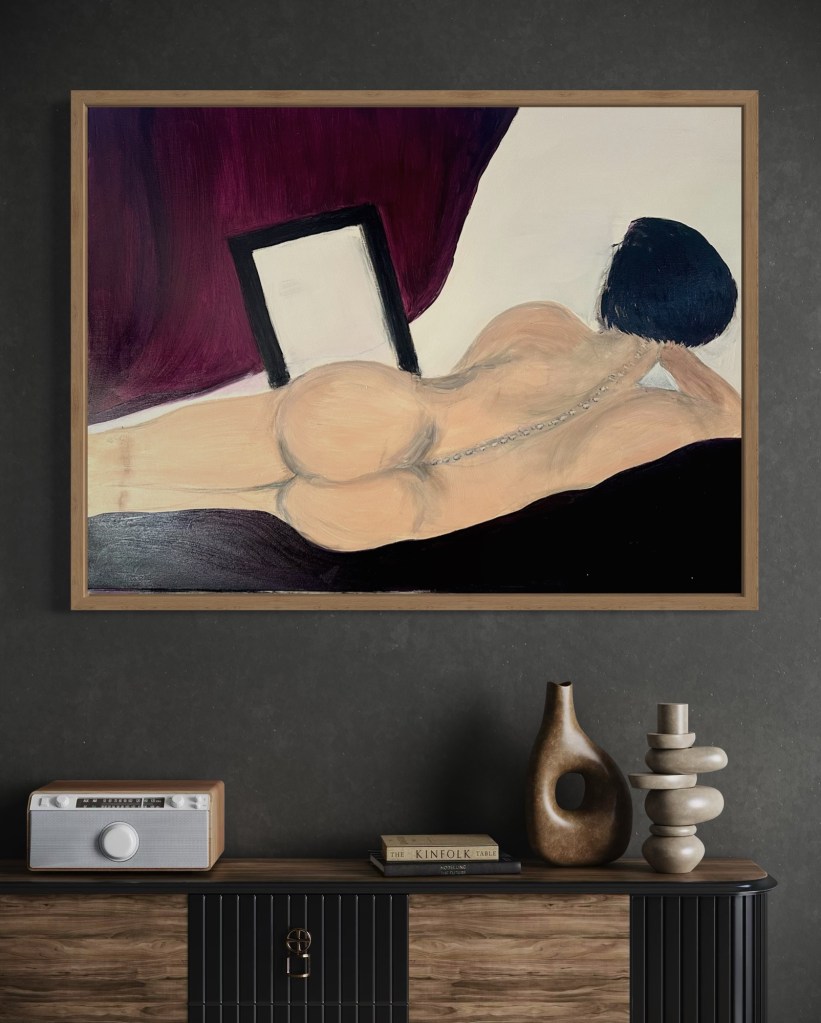
In the absence of work at the moment my small creative endeavours take precedence. I think truly they can save me. Each day I find some reason (other than going to the hospital) to keep moving forwards. A painting to finish, some new technique I want to try, an open studios on the horizon. A song to practice. It’s activity for activity’s sake in some ways but when I paint I am in such a magical zone that everything else disappears. It’s just me and the puzzle in front of me. An idea in my head, a shape in my mind’s eye, a mood or feeling I want to express and a brush, a canvas, some medium, and paint. So simple. My mind hits a neutral unthinking space and no longer tries to solve things intellectually. But once I start I am locked in a sort of battle or dance with what’s in front of me. Sometimes I paint three or four paintings at a time. I would still say I do not know how to paint but it no longer bothers me and I don’t really want to learn. It would change things Sometimes I paint best by taking away. Creating a negative space in something I’ve painted, I work quickly with my hands and a sponge or wipes. The other days I painted a nude mainly with my hands. It was like running my fingers over my own body and I knew the shapes. I could create a flow in the lines, describe my muscular structure and pinpoint my tumours, an exercise in connection. It was almost like feeling under my skin to describe them with shadow and form.
There’s a brilliant book by Marion Milner called ‘On Not Being Able to Paint’. It’s a non painter’s guide to painting. A call to summon the unconscious through automatic drawing and mark making. It made a big impression on me. It was liberating. I’d like to offer a course for can’t paint painters where I promise not to teach them to paint at all but to express and worry less about producing something other people might define as ‘good’. I really do appreciate and envy the skill of my well trained fellow artists on Johnson’s Island. But I like to do my thing and chuck paint around till it makes some pleasing representative shapes and seems to convey mood or meaning. I’m very inspired by Japanese artist friends I’ve met who retain some of the tradition of calligraphy with big emphatic physical gestures. The successful gesture that drives the creation requires an absolute commitment to a single stroke. Expressive but intentional. A lifetime of practice behind a line or a symbol. I used to watch a tiny older Japanese lady who shared a studio space with me as she arrived to paint, meditated on a source image – in her case geological or meteorological, representations of the effects of climate change – and then commit to painting five or six large strokes which appeared to channel all her might. She would breathe deeply as she stood before her canvas and then launch herself at it with controlled power. And then she would leave without saying a word. I observed in silence respecting her space in the zone. Later I found out that her affinity with climate change imagery, endless tear sheets from New Scientist, was because she had been caught up in the Boxing Day tsunami in Indonesia. She was painting the arbitrary power of nature that had traumatised her. And when she confessed this to me she said she’d come back to the UK after experiencing the tsunami and people would ask ‘how was your holiday?’ And she’d say ‘fine thank you’. Because how do you begin to express what you saw, what you just lived through? So she painted it instead. It was the only way she could process it. Sometimes, more and more for me these days, there are some things you simply can’t describe with words.
So, having recovered a bit from the start of the week I’m off to paint and see what comes up. My fourth hospital trip of the week not till 5pm. No plan. Apart from adding few black and silver rhinestones to my self portrait and deciding if it needs anything else. Lucky me.

 Breathe
Leave a comment